What Gets Built
Hardscaping Services in Scranton & Lackawanna County
Patio Installation
Paver and natural stone patios built for NEPA's freeze-thaw climate. What keeps a patio flat is what goes under it: at least 4 in. of compacted crushed stone (more on wet or clay soil), a 1 in. sand bed, and edge restraints. Without them a patio heaves or shifts after its first winter.
- Tier 1: standard concrete pavers
- Tier 2: tumbled / textured interlocking stone
- Tier 3: natural slate, bluestone, flagstone
- Base depth sized for PA winters
Retaining Walls
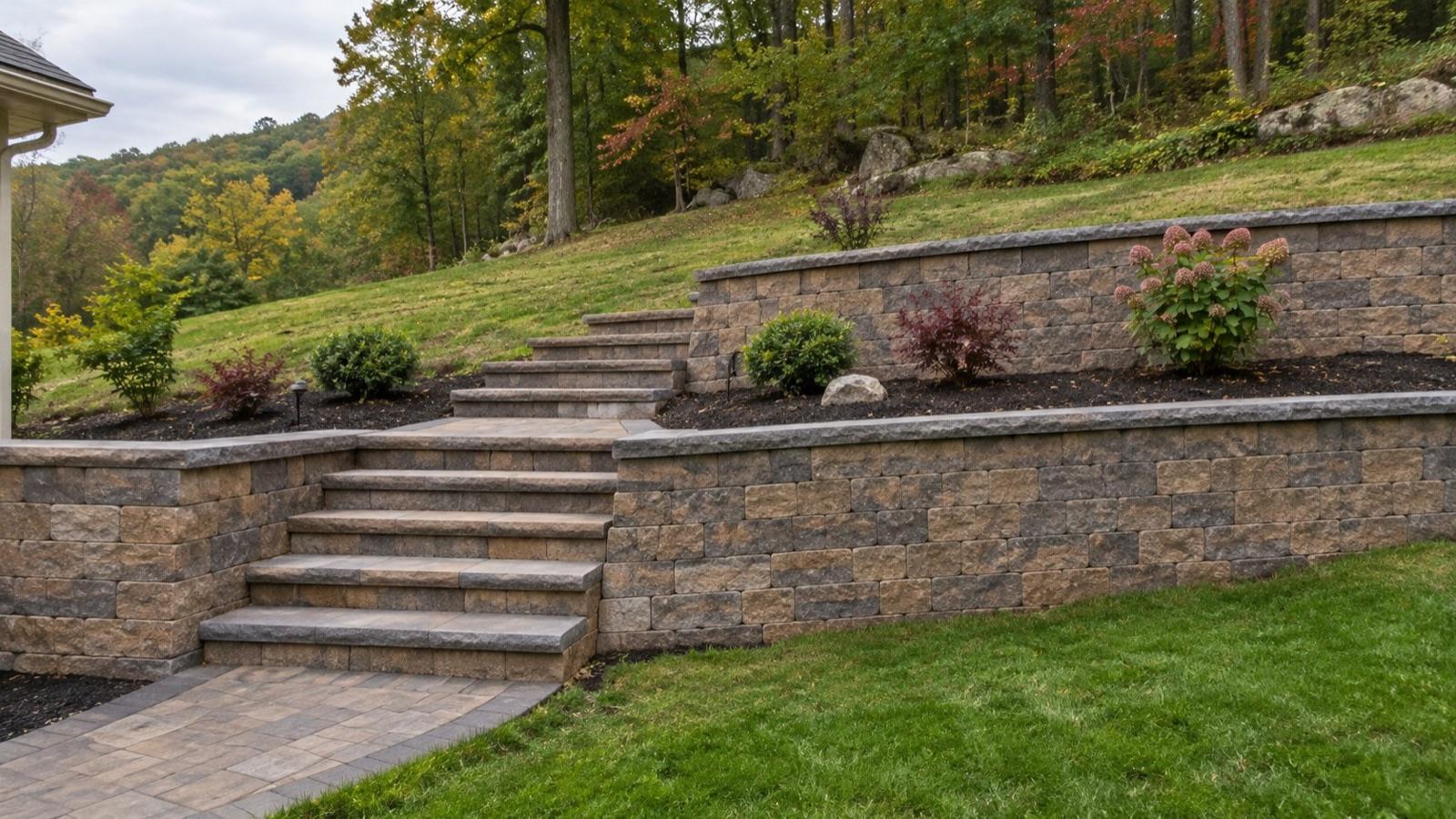
On Scranton's hillsides, a retaining wall is often structural: it holds the grade so the yard above it can be used. These walls deal with wet soil, freeze-thaw cycles, and the weight of the slope. Drainage gravel behind the block and a perforated pipe at the base relieve the water pressure. Walls over about 4 ft typically need an engineered design and a permit.
- Segmental block systems (Allan Block class)
- Architectural split-face block
- Natural fieldstone and cut stone
- Terraced walls instead of one tall wall
Paver Driveways
Paver driveways suit Scranton's winters: individual pavers flex slightly with freeze-thaw movement, and any damaged section can be replaced without repaving the whole driveway. Driveways need a deeper base than patios: 6–8 in. of compacted stone at minimum, more on poor soil.
- Concrete and brick paver systems
- Permeable paver options for drainage
- Soldier-course borders and accent patterns
- Single pavers replaced, not whole sections
Walkways & Steps
Front walkways and entry steps are the first thing anyone sees at your home. Steps need a footing below the frost line (about 36 in. in this part of PA). Walkways need the same compacted base as a patio, or they settle after a few winters.
- Paver and natural stone walkways
- Precast and natural stone steps
- Landing pads and transitions
- Lighting-ready installation available
Outdoor Living Spaces
Fire pits, outdoor kitchens, seating walls, and multi-level outdoor rooms: the upgrades that turn a patio into the place everyone ends up. The estimator prices each one as an add-on, so you can see what a full build costs before anyone visits.
- Built-in fire pits, wood or gas
- Freestanding seating walls
- Stone outdoor kitchens and BBQ enclosures
- Integrated LED hardscape lighting
Paver Restoration & Sealing
Pavers that have faded, grown weeds in the joints, or lost their sand can usually be brought back without replacing them. The process is a deep clean, fresh polymeric sand in the joints, and a sealer. It's done in spring or fall, when it's warm and dry enough for the sand and sealer to cure, and it's priced on the Restore & seal tab of the estimator.
- Deep cleaning
- Polymeric sand re-sanding
- Sealing
- Sunken or heaved sections relaid
How It Works
How a Hardscape Project Goes
Price It Online
Enter your measurements and material tier, and get a planning range plus base stone quantities right away.
Site Visit & Quote
A local hardscaping contractor reviews your layout, walks the site, and gives you a written quote. Permit needs come up here.
Base Preparation
Excavation, grading, compacted gravel base, and drainage setup. This is the most important part of any hardscape project.
Installation & Finish
Surface material installed, edge restraints set, joints filled, site cleaned. A final walkthrough with the contractor.
Local Knowledge Matters
Hardscaping in Scranton: What the Climate Demands
Lackawanna County winters cycle the ground through freezing and thawing again and again between late fall and early spring. That freeze-thaw cycle is the main enemy of outdoor hardscaping — water expands by roughly 9% when it freezes, and that expansion pushes on the soil, concrete, and stone around it.
A patio or retaining wall built without accounting for this will fail. Concrete slabs crack. Mortared walls crack and spall. Pavers without proper base prep shift and sink. Steps without frost-depth footings tip forward. This isn't a matter of if — it's a matter of when.
The solution is base preparation. For patios, that means excavating 6–8 inches, laying compacted stone aggregate in lifts, and finishing with a sand setting bed before any surface material goes down. For retaining walls, that means a compacted base pad, a proper batter angle, about 12 inches of drainage gravel behind the block, and a perforated pipe at the base to relieve water pressure (Allan Block installation manual). Steps and anything mortared need footings below the frost line, about 36 inches in this part of PA.
Hillside lots add another layer. In much of Scranton, a level patio means cutting into the slope and holding it with a wall, so the wall and the patio have to be designed as one system. The estimator prices them separately so you can see what each piece costs.
Common Questions
Hardscaping FAQ — Scranton, PA
Get Started
Hardscaping Quote — Scranton & Lackawanna County
Describe the project and a local hardscaping contractor will follow up. For an instant range first, use the estimator.
Service area
Scranton · Dunmore · Dickson City · Taylor · Old Forge · Moosic · Clarks Summit · Carbondale · Olyphant · Archbald · and surrounding Lackawanna County